

The Ocean’s Greatest Giant: The Incredible True Story of the Megalodon Shark That Once Ruled the Seas
Imagine standing on the deck of a ship and looking into the ocean below. Suddenly, a shark longer than a school bus glides beneath the waves. Its mouth is large enough to swallow two adults standing side by side, and each tooth is nearly the size of a human hand.
It sounds like something from a Hollywood movie—but millions of years ago, such a predator really existed.
Meet Megalodon, one of the largest and most powerful sharks ever to inhabit Earth’s oceans. Although it became extinct long before humans appeared, this legendary predator continues to fascinate scientists, filmmakers, and ocean lovers alike. Fossil discoveries around the world have revealed an extraordinary animal that dominated ancient seas for millions of years.
A Giant Unlike Any Shark Alive Today
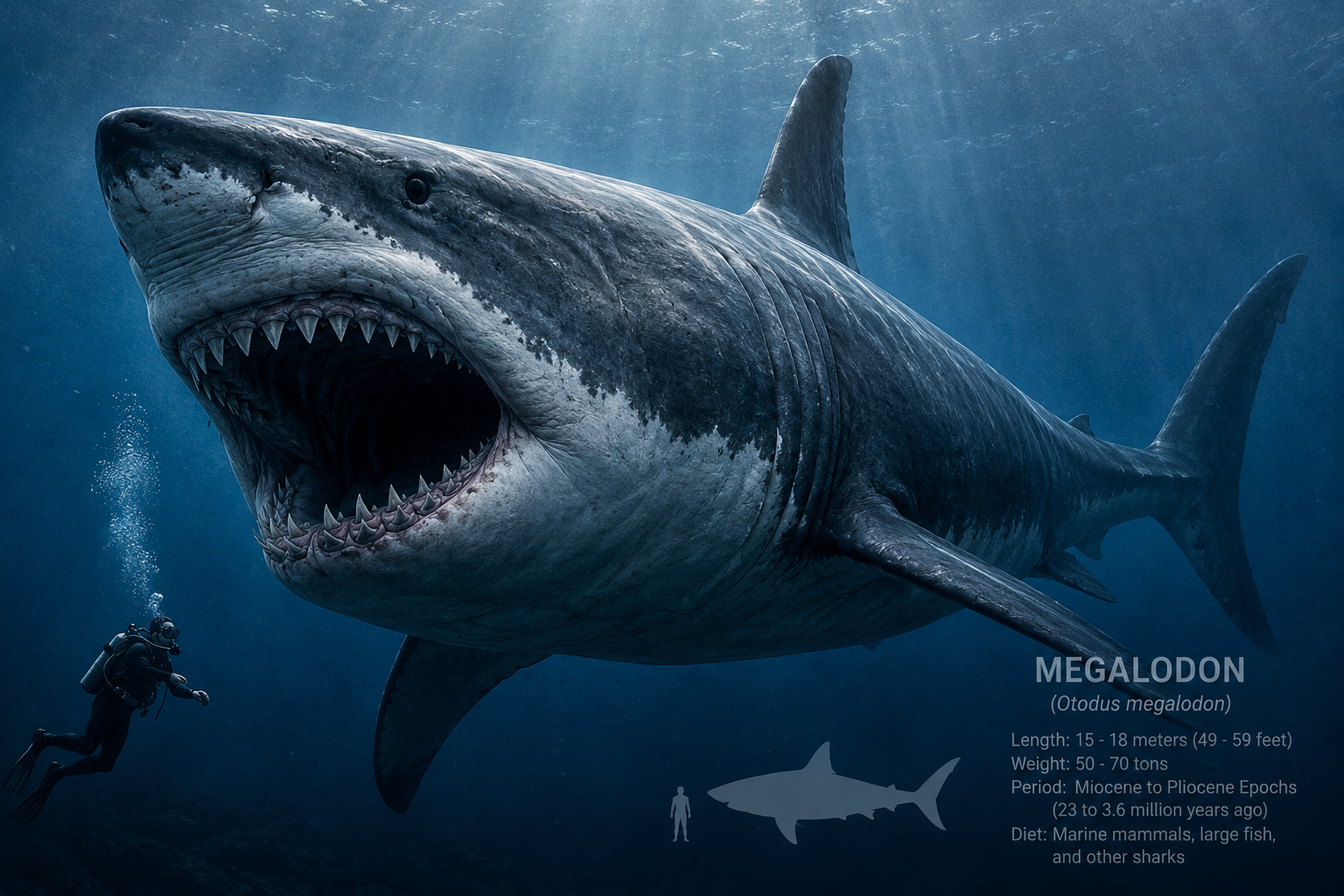
The scientific name of the Megalodon is Otodus megalodon. It lived approximately 23 million to 3.6 million years ago, during the Miocene and Pliocene epochs.
Unlike the modern great white shark, Megalodon reached astonishing dimensions. Current scientific estimates suggest adults commonly measured around 50 to 65 feet (15–20 meters) in length, making them among the largest predatory fish ever known.
Its massive jaws were lined with hundreds of serrated teeth designed to slice through flesh and bone. Some fossil teeth measure more than 7 inches (18 centimeters) long, making them the largest shark teeth ever discovered.
These enormous teeth are among the main reasons scientists know so much about the species today.
Built to Hunt Giants
Millions of years ago, Earth’s oceans looked very different.
Large whales, seals, dolphins, sea cows, and giant sea turtles filled warm coastal waters. Megalodon evolved into an apex predator capable of hunting many of these animals.
Researchers believe it preferred large marine mammals because they provided enormous amounts of energy.
Fossil whale bones discovered in several countries show bite marks matching Megalodon’s distinctive serrated teeth.
Some skeletons even reveal partially healed wounds, suggesting a few whales survived attacks before later dying from other causes.
Scientists think Megalodon often targeted the fins or tail first, preventing prey from escaping before delivering a fatal bite.
How Powerful Was Its Bite?
Few animals in Earth’s history possessed jaws as powerful as Megalodon’s.
Biomechanical studies estimate that its bite force may have exceeded 100,000 newtons, making it one of the strongest bites ever calculated for any vertebrate.
Such incredible force allowed the shark to crush bones and penetrate thick whale skeletons.
Unlike many modern sharks that swallow smaller prey whole, Megalodon could dismantle enormous animals piece by piece.
Its gigantic body required vast amounts of food, making efficient hunting essential for survival.
Fossils Found Around the World
Unlike dinosaur skeletons, complete Megalodon skeletons have never been found because shark skeletons are made mostly of cartilage, which rarely fossilizes.
Instead, scientists rely primarily on fossilized teeth and vertebrae.
Thousands of Megalodon teeth have been discovered on nearly every continent, including North America, South America, Europe, Africa, Asia, and Australia.
Many fossils are found in riverbeds, coastal cliffs, and ancient seabeds that were once underwater millions of years ago.
Collectors highly value these fossils because of their impressive size and excellent preservation.
Some museums display teeth that are larger than an adult’s palm.
Why Did Megalodon Disappear?
Perhaps the greatest mystery surrounding Megalodon is its extinction.
Scientists believe several factors combined to end the reign of this giant predator.
As Earth’s climate cooled, sea levels changed and many warm coastal habitats disappeared.
At the same time, many marine mammals evolved new migration patterns or moved into colder waters beyond Megalodon’s preferred range.
Competition may also have increased.
Smaller, faster predators—including the ancestors of modern great white sharks and early killer whales—likely competed for similar prey.
Because Megalodon required enormous quantities of food, even modest environmental changes could have placed tremendous pressure on the species.
Around 3.6 million years ago, the fossil record indicates Megalodon vanished.
Is the Megalodon Still Alive?
Despite countless internet rumors and fictional movies, there is no scientific evidence that Megalodon survives today.
Modern oceans have been explored extensively by researchers, commercial fisheries, submarines, and satellite technology.
An animal of Megalodon’s size would require huge food resources and would almost certainly leave unmistakable evidence, including fresh teeth, carcasses, DNA traces, or verified sightings.
None have been found.
Stories claiming that Megalodon still lurks in deep ocean trenches remain fictional and are not supported by marine science.
Its legend survives because its true size was already astonishing enough.
Why Megalodon Still Captivates the World
Few prehistoric animals capture human imagination quite like Megalodon.
Its enormous teeth are among the most recognizable fossils ever discovered.
It has inspired documentaries, novels, museum exhibits, and blockbuster films.
For paleontologists, Megalodon provides valuable insight into the evolution of sharks, ancient marine ecosystems, and how environmental change can reshape life on Earth.
Every new fossil helps researchers refine estimates of its size, behavior, and hunting strategies.
Although it vanished millions of years ago, the giant shark continues to teach scientists about oceans that existed long before humans.
Lessons From an Ancient Giant
The story of Megalodon is not simply about the biggest shark that ever lived.
It is also a reminder that even the most dominant predators are vulnerable to changing environments.
For millions of years, Megalodon ruled the seas with unmatched power.
Then shifting climates, changing ecosystems, and evolving competitors gradually ended its reign.
Today, only fossils remain—but those fossils tell one of the greatest stories in natural history.
Every massive tooth found along an ancient shoreline is a message from a world that disappeared long before people walked the Earth.
And although Megalodon no longer patrols our oceans, its legacy continues to inspire curiosity, scientific discovery, and awe in anyone who imagines what it must have been like to share the sea with the greatest shark of all time.
Image Alt Text (6–7 Images)
- Artist’s reconstruction of a giant Megalodon swimming through a prehistoric ocean.
- Size comparison between a Megalodon and a modern great white shark.
- Fossil Megalodon teeth displayed in a natural history museum.
- Artistic scene of a Megalodon hunting ancient whales.
- Paleontologist examining a large Megalodon fossil tooth.
- Ancient ocean ecosystem featuring Megalodon and prehistoric marine life.
- Illustration comparing the size of a Megalodon with a human diver.
SEO Meta Description
Explore the incredible true story of the Megalodon, the largest shark ever to live. Discover its immense size, powerful bite, fossil discoveries, hunting habits, extinction, and the science behind one of history’s greatest marine predators.