

4
🌿 7 Hidden Amazon Animal Stories That Even Experienced Wildlife Lovers Rarely Know
Category: Wildlife | Nature | Amazon Rainforest
Tags: Amazon rainforest, hidden wildlife, rare Amazon animals, wildlife stories, rainforest biodiversity, jungle animals, South America, exotic wildlife, nature facts, conservation
Meta Description:
Explore seven fresh stories about little-known Amazon wildlife, including transparent butterflies, tiny squirrels, freshwater stingrays, camouflaged frogs, and remarkable rainforest spiders.
7 Hidden Amazon Animal Stories That Even Experienced Wildlife Lovers Rarely Know
Every year, millions of visitors dream of seeing the Amazon Rainforest. Most hope to spot jaguars, giant snakes, or colorful macaws. Yet many of the rainforest’s most fascinating animals are far smaller, quieter, and easier to overlook.
These hidden species have evolved extraordinary survival strategies that demonstrate just how inventive nature can be. From transparent wings to underwater camouflage, their stories reveal a side of the Amazon that few people ever experience.
1. The Tiny Spider That Builds a Mystery
Alt Text: Small Amazon spider beside a unique silk “Silkhenge” web structure.
In 2013, scientists exploring the Amazon discovered a strange web unlike anything they had seen before.
Nicknamed “Silkhenge,” the tiny structure looked like a miniature fence surrounding a delicate silk tower.
For years, researchers debated its purpose before discovering it protected spider eggs from predators and parasites.
The discovery reminded scientists that even in the modern age, the Amazon still holds surprises hidden in plain sight.
2. The Butterfly You Can Almost See Through
Alt Text: Glasswing butterfly with transparent wings resting on a leaf.
The glasswing butterfly appears almost invisible in flight.
Most of its wings are transparent because they lack the colorful scales found on other butterflies.
This unusual adaptation makes it extremely difficult for birds to detect as it glides through patches of sunlight in the forest.
Its nearly invisible wings are one of nature’s most elegant forms of camouflage.
3. One of the World’s Smallest Squirrels
Alt Text: Tiny Amazon dwarf squirrel climbing a tree trunk.
The Amazon dwarf squirrel is only about the size of a human hand.
Despite its tiny body, it moves rapidly through the treetops searching for seeds, fruit, insects, and fungi.
Its small size allows it to reach slender branches that larger mammals cannot safely climb.
This gives it access to valuable food sources hidden high in the canopy.
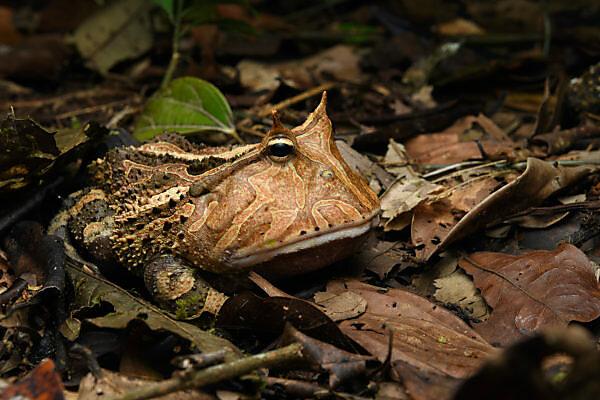
4. The Frog That Looks Like Dead Leaves
Alt Text: Horned frog perfectly camouflaged among brown rainforest leaves.
The Amazon horned frog spends much of its life buried beneath fallen leaves.
Its broad head and earth-colored skin make it almost impossible to distinguish from the forest floor.
Rather than chasing prey, it waits patiently for insects, small reptiles, or rodents to wander close enough for a lightning-fast strike.
Patience is its greatest hunting tool.
5. The Colorful Toucan With a Smaller Beak
Alt Text: Aracari toucan eating berries in the Amazon canopy.
Aracaris belong to the toucan family but have slimmer bodies and shorter beaks than their larger relatives.
They travel through the canopy in noisy groups searching for fruit, insects, and small animals.
As they eat fruit, they carry seeds throughout the forest, helping regenerate new trees over large distances.
Without birds like aracaris, many rainforest plants would struggle to spread naturally.
6. The Stingray That Lives Far From the Ocean
Alt Text: Freshwater stingray resting on the sandy bottom of an Amazon river.
Many people are surprised to learn that stingrays also live in freshwater.
Amazon freshwater stingrays spend their lives in rivers rather than the sea.
Their flattened bodies allow them to hide beneath sand while waiting for fish and small invertebrates.
They are highly adapted to freshwater habitats and represent one of the Amazon River’s most unusual predators.
7. The Giant Tree That Supports an Entire Community
Alt Text: Massive kapok tree rising above the Amazon rainforest canopy.
The towering kapok tree can reach more than 60 meters (200 feet) in height.
Its enormous branches provide nesting sites for birds, resting places for monkeys, and pathways for countless insects.
Epiphytic orchids, bromeliads, mosses, and vines all grow upon its trunk and branches.
Rather than supporting just one species, a single mature kapok tree becomes an entire ecosystem in itself.
Every Discovery Leads to Another
Despite centuries of exploration, scientists continue finding new Amazon species every year.
Improved technology, including drones, camera traps, and DNA analysis, reveals animals that were previously impossible to study.
The rainforest remains one of Earth’s greatest natural laboratories.
Protecting Hidden Wildlife
Many lesser-known Amazon animals receive far less public attention than famous species.
Yet each one contributes to pollination, seed dispersal, pest control, or nutrient cycling.
Conserving the Amazon means protecting not only its iconic wildlife but also the countless small creatures that quietly keep the ecosystem functioning.
Final Thoughts
The Amazon’s greatest treasures are often its least famous inhabitants.
Transparent butterflies, mysterious spiders, tiny squirrels, and freshwater stingrays demonstrate that extraordinary adaptations come in every size.
As scientists continue exploring this remarkable rainforest, countless more hidden stories are waiting to be discovered
Leave a Reply